I’m sitting with my parents in India, drinking my morning chai, watching CNN. The peace talks between Iran and the US have collapsed. And I notice my heart sinking. Not intellectually — I feel it in my body. A heaviness in my chest that wasn’t there a moment ago.
Grief — for the people whose lives are being torn apart by forces they didn’t choose. Anxiety — for what this means for the rest of the world, for all of us. And anger — at the leaders responsible for creating unnecessary suffering, for choosing ego over the lives of real human beings.
I notice all of it arising, right there over morning chai. The contact — images on the screen. The feeling tone — deeply unpleasant. The perception — this is wrong, this shouldn’t be happening. And then the impulse — to scroll more, to argue with the television, to carry this heaviness into the rest of my day.
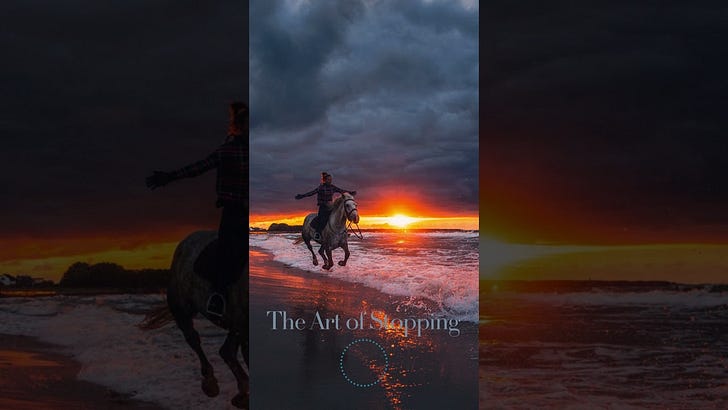
The horse is already galloping. (I’ll explain the horse in a moment.)
But this is exactly why inner calm matters. Not to bypass what I’m feeling — the grief is real, the anger is warranted. But because without stopping, I lose my clarity. I lose my ability to choose how I want to respond to a world in conflict. I lose access to the very wisdom that might actually be useful — to my family, my community, my students, the people I serve.
And here’s the thing — whether the moment is geopolitical, watching peace talks crumble on a screen in India, or personal, buying a $5 cap on a street in Hanoi, the inner process is the same:
Something makes contact with our senses — Feelings arise — Habits take over — And before we know it, we’re being carried somewhere we didn’t choose to go.
It happens quickly. Quietly.
And if we’re not paying attention, we’re already inside it.
Inner calm is how we get our agency back to see clearly and choose intentionally.
• • •
What Inner Calm Actually Is (And What It Isn’t)
Inner calm is the experience of tranquility — physical and mental — that we can access regardless of our circumstances. Its function is twofold: composure and clarity. When the mind is tranquil, we can see clearly. When we see clearly, we can act wisely.
Do you have the patience to wait
till your mud settles and the water is clear?
Can you remain unmoving
till the right action arises by itself?
— Lao Tzu, Tao Te Ching
Like muddy water — when you stop stirring it, the mud settles, and you can finally see through to the bottom.
But here’s what inner calm is not: it’s not suppression. It’s not telling ourselves we shouldn’t be angry about failed peace talks, or worried about the state of the world, or frustrated by our own patterns. It’s not forcing peace. Inner calm is what naturally arises when we let go of our attachments to how things should be.
The grief I felt watching CNN this morning? Real. The anger? Warranted. But without stopping, I lose my clarity. I lose my ability to respond to a world in conflict with wisdom rather than reactivity. And that’s the part that might actually be useful in challenging situations.
Inner calm isn’t the absence of feeling. It’s the presence of clarity within the feeling.
• • •
Ask the Horse
There’s a Zen parable:
A horse is galloping down a village road. The rider seems to be in a great hurry. A villager on the side of the road calls out, “Where are you going?” And the rider shouts back, “I don’t know! Ask the horse!”
The horse is our mind — our habits of rushing, judging, striving, reacting. And we, the rider, have given up all control. We’re being taken here and there by the momentum of conditioning, and we don’t even realize we’ve lost the reins.
This isn’t abstract. Think about the last time you doom-scrolled through the news and couldn’t stop. Or the last time you snapped at someone you love and wondered, why did I say that? Or the last time you bought something on impulse and felt that restless aftertaste. That’s the horse running.
The art of stopping is how we learn to take back the reins.
• • •
The $5 Cap: What Happens in the Split Second Before You Choose
A few weeks ago, walking through the streets of Hanoi with my family, my son spotted a Patagonia cap. Five dollars. Without much thought, we bought it.
It wasn’t until later — when my husband asked, what was the ethics of buying a $5 Patagonia cap on the streets
? — that moment became a mirror.
Buddhist psychology offers a precise map of what unfolds in the split second before we act. These mental factors don’t arise one after another — they fire simultaneously, in a single moment:
Contact — the eyes meet the cap. Sense organ, sense object, and consciousness come together.
Feeling tone (vedanā) — instantly, a pleasant feeling. Patagonia! Only five dollars!
Perception (saññā) — recognition kicks in, shaped by memory. Patagonia is cool. Great brand. Sustainable. The pattern recognition shapes the experience before we even know it’s happening.
Cetanā (intention/volition) — the impulse to act. I want that. This is the most critical of the mental factors — what the Buddha identified as the seed of karma. It’s not the action itself that creates consequences, he taught. It’s the intention before the action.
But here’s what makes cetanā so powerful and so tricky: it’s never just one intention. It’s layered. In that moment with the cap, there wasn’t just a simple “I want.” There was: Patagonia — that’s a cool brand. It would look great on me. Only five dollars — what a steal. I’d never get this deal back home.
Can you see the layers? There’s desire — I want. There’s identity — this will make me look a certain way. There’s comparison — this is a better deal than I’d get elsewhere. There’s scarcity — if I don’t get it now, I’ll miss out. And underneath all of it, there may be greed — the pull toward getting more, getting it cheap, getting the win of a bargain.
None of these layers announced themselves. They fired together, invisibly, dressed up as a single thought: great deal, let’s get it.
Attention (manasikāra) — everything else falls away. Full attention locks onto the cap. Our values, our questions about where it came from and who made it — gone.
The whole chain fires and completes before the conscious mind has any say. We later learned the cap was likely counterfeit — made in sweatshops, possibly with dyes harmful to the skin. Had we stopped, we might have asked questions. We might have chosen differently.
This is why stopping matters so much at the level of cetanā. When we pause and ask — what is actually driving this impulse? — we start to untangle the layers. Is this intention informed by greed, by comparison, by habit? Or is it informed by clarity — by my values, by what I actually need, by the kind of person I want to be in the world?
That one question — what is my intention here? — is the entire practice.
And this same chain is firing in you right now, as you read this. It fires when you watch the news. It fires when you reach for your phone. It fires in every moment of every day. The question isn’t whether it’s happening. It’s whether you can see it.
• • •
What Stopping Actually Looks Like
This is where it gets real. Because the art of stopping isn’t just a concept — it’s something people are actually practicing, in the middle of ordinary life.
One practitioner shared buying a homemade coffee cake from a local family-run farm stand. She walked through the same chain — contact, pleasant feeling, recognition — but here the intention was wholesome: supporting local, choosing fresh ingredients, nourishing her family. Stopping didn’t mean not buying. It confirmed the choice. The art of stopping isn’t always about saying no — sometimes it’s about saying yes with your eyes open.
Another share ended with a different outcome. The practitioner had been searching for a rain parka for weeks — online, in stores. She nearly settled for one that met every criterion except the feel and color. Almost bought it. Then she decided: I’m just going to wait. I’ll duct-tape the old one.
A few days passed. And she said: “I feel calm about my decision. Had I bought it, I’d be stuck in a loop of I shouldn’t have, I shouldn’t have.” That calm is the feedback loop. After any choice, check in with your body. Ease or restlessness? That tells you everything.
She also named something profound: “You kind of have to step away from the decision to decide. It didn’t come from me. It came through me.” That’s Lao Tzu’s invitation in action: Can you remain unmoving till the right action arises by itself? It takes patience. It takes trust. And it takes practice.
• • •
The 90-Second Rule
Here’s a piece of neuroscience that makes all of this more possible: as neuroscientist Jill Bolte Taylor revealed — and as I explore in my book Return to Mindfulness — every emotion lives in the body for about 90 seconds. The chemical surge arises, peaks, and dissolves.
Ninety seconds. That’s all.
The reason we experience negative emotions for hours, days, and sometimes years is not because of the original surge. It’s because we keep stoking the fire with our narratives. We replay. We add meaning. We catastrophize. We loop.
Think about that morning with CNN. The images hit. The grief surged. If I had just stayed with the feeling — just the raw sensation in my chest, without the stories — it would have moved through me in under two minutes. Instead, I could have carried it all day, layering story on top of story, feeding the fire.
So I stopped. I breathed deeply. I let the wave move through me — not pushing it away, not feeding it with narratives. And when the mud settled, I checked in: what can I actually do about this?
Because here’s what I realized: those of us watching this crisis from the outside can either add to the suffering — more hate, more outrage, more divisiveness — or we can choose differently. We can cultivate inner calm so that our response creates peace rather than more conflict. Clarity rather than more noise. So that when it’s time to act — to speak up, to vote, to choose leaders — we’re choosing from wisdom, not reactivity. Choosing leaders not driven by personal agendas but by the wellbeing of all.
That’s why I sat down to write this. Not to escape the grief. To let it move through me clearly enough to do something useful with it.
• • •