


At all times and in any situation, how can I make mindfulness my constant habit? —Shantideva, The Way of the Bodhisattva
Many of us who practice mindfulness or yoga know the space between trigger and response. It’s the heart of what we train for — that pause where, instead of reacting automatically, we get to choose. Viktor Frankl, the psychiatrist and Holocaust survivor, pointed to it: between what happens to us and what we do next, there is a space, and in that space is our freedom to choose our responses.
But here’s the question that is seldom discussed: once you’re in that space… then what?
We’re taught how to get there. Breathe. Slow down. Bring non-judging awareness to what is here. Maybe even radical acceptance. And then — we jump to what we think is the right thing. I shouldn’t be angry. I should be kind. I should let go.
Those feel like wisdom. But notice where they came from. They’re not fresh responses to what’s actually happening in front of us. They’re defaults. Old rules. The same conditioned reactions we’ve always had, just dressed up as mindfulness. We make the space… and then we fill it with autopilot.
So what is often missing in that space?
Listening. Really seeing what’s here — underneath the shoulds, underneath the story we’re already telling ourselves, underneath the judgment that’s decided everything before we’ve even looked. Listening is the missing step between calming down and responding skillfully. It’s where calm becomes wisdom.
And it’s much harder than making the space. Because the moment we go to look, our biases have already decided what we see. We don’t see what’s in front of us. We see our idea of it, shaped by our past experiences and what we want to see. Researchers estimate we run on this kind of autopilot most of the time.
And here’s why that matters far more than this post: it’s the same thing that keeps us stuck everywhere that counts — not really seeing the people closest to us, not connecting, reacting instead of choosing. The biases we can’t see are running the show.
So let me show you those biases — not as a concept, but as an experiment. And you are the researcher of your own mind.
As you read the rest of this, watch your own mind. I’m going to name eight skills, and each one will show you a default you’re running right now, in real time — how that same default plays out in the parts of your life that matter, and how the skill disrupts it. These eight are what listening actually requires. They’re how we see past our biases and finally respond based on a deeper understanding of the situation and our intentions.
Awareness. Notice, first — are you even fully here? Or is part of you already somewhere else: another tab open, the next thing on your list, a quiet voice weighing whether this is worth your time? Most of us live from the neck up, lost in thought, barely in our bodies at all. And it doesn’t stay in the reading. It’s the same absence that has you finish a drive with no memory of it, eat a meal without tasting it, reach the end of a hard conversation without ever noticing you struck the first match. You can’t listen in a space you’re not even present for. Awareness disrupts the autopilot by doing one simple thing: catching yourself. Coming back — into the body, into the moment. It’s where everything begins.
Compassion. Now notice what fired the instant you became aware — a judgment. I like this. I don’t. This is good; this is nonsense. Before you understood anything, the mind had already sorted it. That same snap-judgments run on everyone you meet — the coworker, the teenager, the stranger online — judgment first, and connection is lost before it had a chance. You cannot truly listen to someone you’ve already convicted. Compassion disrupts the reflex: it meets the judgment with kindness and holds the moment open, so a person can be more than your first verdict of them.
Curiosity. Here’s the trap underneath even that: we can’t see what we can’t see. Your judgment feels like plain truth, because you have no access to what it’s filtering out. Right now, some part of you may be certain — I already know this — and that very certainty is the problem. It’s the same blindness that makes you sure you already understand the argument, the person, the other side, so you stop looking, and the gap never closes. This is confirmation bias. Curiosity disrupts it with a single question: what am I not seeing here? It’s what turns listening from waiting-to-reply into actually receiving new information even when it is uncomfortable. You cannot learn anything your mind has already filed as known.
Energy. And now the quietest default of all — the pull to not bother. We are wired to resist change. This is the status quo bias. Being aware with compassion and curiosity takes effort. So if you are still here, congratulations! You are doing the work! Research on online videos finds that more than half of viewers drop off before a video even reaches its point. I don’t think that’s because they’re not interested. Going past what you already know takes effort, real effort, and the mind is wired to conserve it. So if you’ve read this far, more than half the people who started are already gone — and you are doing the skill right now. This is the same default that keeps us in stuck jobs and stuck dynamics: not because we don’t know better, but because changing is tiring, and staying the same is easier. Listening well — staying in the discomfort long enough to actually understand — takes energy most of us won’t spend. Energy is the skill of moving through our resistance to do what is needed.
Appreciative Joy. But effort alone burns out. You cannot sustain the hard work of seeing clearly — day after day, in the same difficult relationships — on willpower. Notice if some part of reading this has begun to feel like a chore, scanning for what’s wrong before taking in what might be right. That’s the negativity reflex, and left alone, it makes us quit — on the practice, on the person, on ourselves. Appreciative Joy disrupts it: the capacity to take in the good, to feel gladness in your own small progress and in others’. It’s what makes the effort renewable instead of grinding — the fuel that lets us keep listening, keep showing up, keep going. If you like, take a moment to appreciate the goodness in you, this video, anything else that you can genuinely be grateful about in this situation.
Inner Calm. And yet joy has its own trap. It can become something we chase — grasping at the good feeling, clinging, needing the high. Notice if there’s any grip in you right now: a rush to a verdict, a need to be right, a tightness around wanting this to land a certain way. That same grasping is what makes it impossible to let a slight go, to release an expectation, to stop replaying what should have happened. A gripping mind can’t listen — it’s too busy holding on. Inner Calm disrupts our attachments: the ease of not holding on, even to what’s pleasant. It’s the letting go that steadies everything else.
Focus. Once we’ve let go, something opens. But notice how many times your attention has already drifted just in reading this — pulled toward a notification, a worry, the next task. Scattered attention is why so little of what matters ever lands: we’re never fully with the person, the work, the moment, long enough for it to reach us. You can’t listen to what you can’t stay with. Focus disrupts the scatter — not as strain, but as the natural gathering of a mind that has stopped clutching. It's the ability to stay with the one thing in front of you long enough for it to bear fruit.
Equanimity. And all of it — awareness, compassion, curiosity, energy, joy, calm, focus — strengthens the last. Notice if part of you is already deciding whether this was worth your time: the verdict, the ranking, the reaching toward praise or away from criticism. That grasping at the good and bracing against the bad is what leaves us tossed by every high and low, hooked by our hopes and our fears. It’s hard to listen clearly when you’re this invested in a particular answer. Equanimity disrupts it — the steady ground that holds through the ups and the downs, the wins and the losses. Not indifference. Steadiness. The capacity to stay clear and kind, no matter which way the moment breaks.
That’s the answer to the question we started with. What do you do in the space between trigger and response? You listen — really listen. And these eight skills are what make listening possible. Notice what just happened: you needed every one of them simply to read this well. To stay present, withhold the verdict, get curious, spend the energy, find some joy in it, hold it lightly, focus, and stay steady with something unfamiliar. In most situations you will not need all eight skills. Based on the default patterns you notice, you can invite the relevant skills using this table.
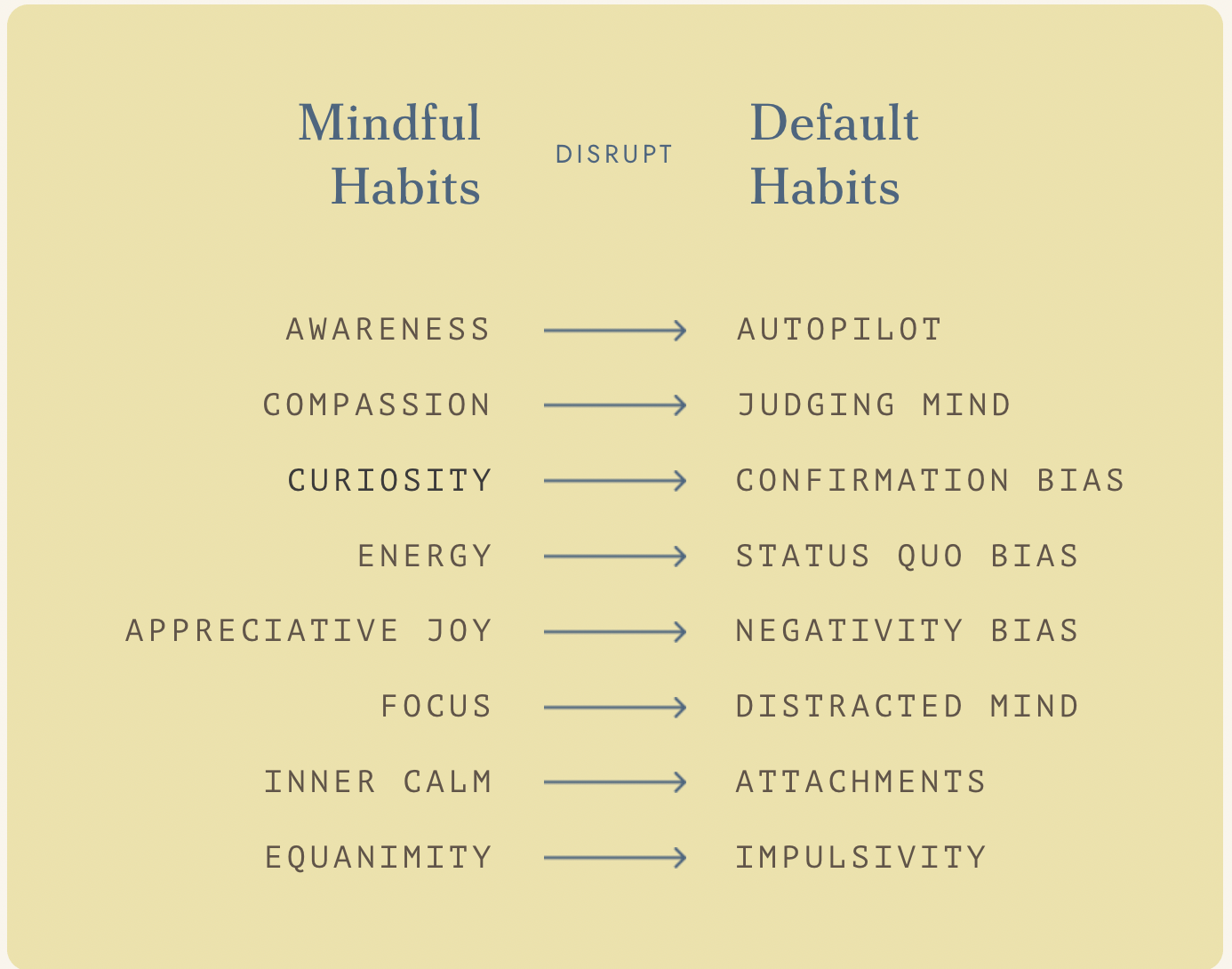
These aren’t abstract virtues. They’re the exact capacities that decide whether you see clearly or stay on autopilot — here, and in every moment of your life that actually matters. The hard conversation. The decision under pressure. The relationship you can’t seem to fix.
So here’s where to begin. At asamalife.com, take the free assessment to see where you naturally stand across the eight skills, and where there’s room to grow — or go straight to the wheel and choose the one you need most right now.
And starting next week, I’m opening Daily Sama — free, live micro-practices where we stop reading about these skills and start training them together, one skill at a time. Here’s the full schedule — each day, a skill, the moment it meets, and the practice we’ll do together:
The 8 Skills — Daily Sama Live
Awareness — When You’re Living From the Neck Up · “There Is a Body”
https://open.substack.com/live-stream/260099?utm_source=live-stream-scheduled-upsellSelf-Compassion — When You’re Waiting to Be Seen · “I See Me”
https://open.substack.com/live-stream/260134?utm_source=live-stream-scheduled-upsellCompassion for Others — When Your Judgments Block Connection · “I See You”
https://open.substack.com/live-stream/260140?utm_source=live-stream-scheduled-upsellCuriosity — When “Why” Keeps You Stuck · “Ask What, Not Why”
https://open.substack.com/live-stream/260142?utm_source=live-stream-scheduled-upsellEnergy — When You’re Running on Empty · “The Four Rooms”
https://open.substack.com/live-stream/260144?utm_source=live-stream-scheduled-upsellAppreciative Joy — When You Never Feel Good Enough · “Act with Love”
https://open.substack.com/live-stream/260150?utm_source=live-stream-scheduled-upsellInner Calm — When You Can’t Let Go · “Inner Calm, Outer Calm”
https://open.substack.com/live-stream/260153?utm_source=live-stream-scheduled-upsellFocus — When You’re Pulled in Every Direction · “Just Three Breaths”
https://open.substack.com/live-stream/260160?utm_source=live-stream-scheduled-upsellEquanimity — Get Free From the Things That Control You · “Unhook From Hopes and Fears”
https://open.substack.com/live-stream/260164?utm_source=live-stream-scheduled-upsell
Before you go, I’d love to hear from you — leave a comment:
Which default do you catch yourself repeating most often?
There’s no wrong answer. Just noticing is the practice. And naming it out loud — that’s where change begins.
If you found this helpful, please share it. Word of mouth is how real-world mindfulness reaches the people who need it most.
Return. Listen. Begin. Stay Sama. 🪷
Shalini


