

When Suffering Is Everywhere: What Can Dharma Teachers Uniquely Offer?
Silence, Speech, and Skillful Action

Recently, Vince Fakhoury Horn — a Palestinian-American dharma teacher, founder of Buddhist Geeks, and authorized teacher in the Insight meditation tradition — published a powerful and painful podcast titled “Is the Insight Tradition Complicit in Genocide?” In it, he shares that two of his family members have lost over 200 people in Gaza. A whole family tree. He describes the fear for his cousins in the West Bank, his feeling of being utterly alone in his tradition for two years, and his heartbreak at watching the people who trained him in compassion say nothing.
His critique is sharp: that the Insight tradition has been “progressive on everything but Israel.” That silence is complicity — especially for American teachers whose country is directly enabling this violence. That if you teach ethics and sila as a core pillar of dharma, you are claiming to be a teacher of morality and must engage with the moral issues of our time. He says: “If you can’t stand up for what’s good and right, and you’re too scared, you need to pass on the baton. Pass the torch. Put down the Dharma-teacher role and let other people who are ready and willing take it up.”
His words stirred something in me. I want to honor his pain and his critique — and I want to open a dialogue about what dharma teachers can uniquely offer in times of widespread suffering.
My Experience in Amherst
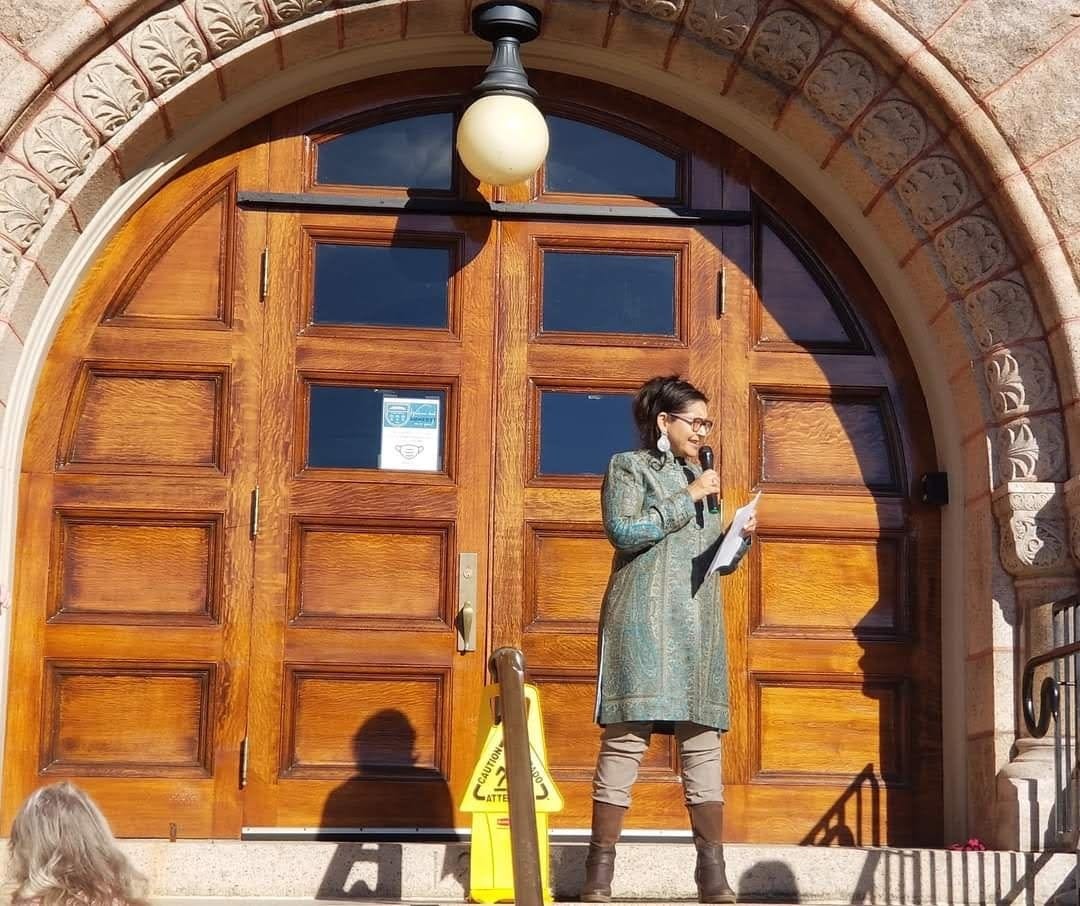
I’m an Affiliated Expert and teach Mindful Marketing at UMass Amherst, founder of Sama Life on Substack, a certified MBSR and Search Inside Yourself teacher, and a former two-term Amherst Town Councilor.
In March 2024, I sat through a five-hour Town Council meeting where our community debated a ceasefire resolution. I fully support ending the humanitarian catastrophe in Gaza. And — I also did something that felt important before the town council meeting: I listened. I sought out Israeli residents in my community whose families live in the region. Many opposed Netanyahu. Many opposed the policies causing Palestinian suffering. And they felt the resolution as written erased their experience entirely.
So I did the work. I read books like The Lemon Tree that hold Palestinian and Israeli narratives together without collapsing into one side. I spoke with Israelis and Palestinians. I sat with the complexity — with the discomfort of holding multiple truths that don’t resolve neatly. And then I drafted an alternative resolution.
This was not a small undertaking. As a former councilor, I was no longer in office. My husband questioned my wisdom in spending so much time on a resolution that (probably) has little consequence. But I felt called to try. My hope was that we could model being a town that held the complexity and pain of all involved — that we could offer an example of right speech that might inspire other cities to adopt similar resolutions, which might in turn inspire leaders at the state and national level.
For me, as a mindfulness practitioner, this was what skillful action looked like: sitting with the suffering, reaching out to people on both sides, listening to their lived experiences, reading, researching, and rewriting. It took months. It was hard. And in the end, my alternative resolution was rejected. The advocates and council had no room for it. The very act of acknowledging Israeli’s fears was treated as betrayal.
But I felt like I did my work.
Interdependence, Not Both-Sidesism
I want to be clear: what I proposed was not the “anemic both-sidesism” that Vince rightly critiques. It was a recognition that lasting peace requires both peoples to feel safe — and their safety is interconnected.
You cannot have security for Israelis without freedom and dignity for Palestinians. You cannot have Palestinian self-determination without addressing Israeli existential fears — fears rooted in the Holocaust, in being sent to establish a new country surrounded by Muslim-majority nations many of which have sought to eliminate Israel, and in decades of terrorist attacks targeting civilians. And we cannot ignore the depth of Palestinian suffering — not only what is happening now in Gaza, but decades of settlements expanding into the West Bank, loss of control over their own land, restricted movement, and life under constant surveillance by the Israeli government.
These are not separate issues. They are intertwined. The trauma and fear on each side fuels the actions that deepen the trauma and fear on the other. This is why lasting peace requires both peoples to feel safe — and why their safety is interconnected.
These are not competing values — they are interdependent conditions for peace. The suffering is interconnected. The liberation must be too.
My resolution included parallel “Whereas” clauses:
“Whereas, Israelis have the right to defend themselves from terrorist attacks and feel safe;
Whereas, Palestinians have the right to live in peace on land that they can defend, govern, and thrive on...”
It named both antisemitism AND Islamophobia. It mourned 1,200 Israelis and 30,000 Palestinians in the same breath. It called for “a peace settlement that ensures enduring safety for all Israelis and Palestinians.” It encouraged residents to “educate themselves about the complexities of the conflict and engage in respectful dialogue with people holding diverse perspectives.”
It was rejected. But I share it because I believe another kind of speech is possible — one that holds Palestinian liberation AND Israeli security as interdependent, not competing, values.
A Genuine Inquiry
Vince’s podcast left me sitting with questions I don’t have easy answers to.
These issues are complex. They require time to understand from multiple perspectives — to read, to listen to those directly affected, to sit with discomfort and uncertainty before speaking. I spent months doing that work before I could draft my resolution. Not every teacher has the ability to do that deep work on every global issue that the USA is involved in.
And there are many. Yemen, for example — where US weapons, targeting assistance, and logistical support have fueled what the UN calls “the world’s worst humanitarian crisis.” Over 150,000 killed, hundreds of thousands more dead from famine and healthcare collapse. US complicity there is arguably as direct as in Gaza. And yet — where is the response from dharma teachers?
I don’t raise this to deflect from Gaza. I raise it as a genuine question: How do we determine which issues warrant a dharma teacher’s voice? Is it the scale of suffering? The directness of US involvement? The media attention? The social pressure within our communities?
Beyond international conflicts, there is also widespread suffering here at home — deep inequities in education, home ownership, business opportunities, healthcare. Systemic harm that doesn’t make headlines but shapes lives every day. This was one of the reasons that I as a mindfulness teacher ran for office. Maybe we need more dharma teachers to explore involvement in politics?
I don’t have a clear answer to what determines which issues we address. But I have come to believe that silence is better than performative statements — speech that flattens complexity, erases voices, or collapses into one side of a binary without truly understanding the lives of all those affected.
What Dharma Teachers Can Uniquely Offer
What I do believe is that there is something all of us can and must do as dharma teachers — something that doesn’t require expertise on every conflict but draws on what we are trained to offer:
Teaching the skills to pause before reacting — to resist the mind’s pull toward simple narratives
Teaching people to listen deeply to those whose experience differs from their own — especially those we might be tempted to dismiss or demonize
Teaching the capacity to hold complexity — to sit with multiple truths without collapsing into one side
Emphasizing the teachings of interbeing — that suffering is interconnected, that the safety of one group is bound up with the safety of another, that liberation must include everyone or it is not liberation (Thich Nhat Hanh’s book, Zen and The Art of Saving The Planet was a useful resource that I returned to regularly when dealing with complex issues in Town Council)
Helping people take skillful action from clarity rather than reactivity — action that addresses root causes rather than just symptoms
This is not a defense of silence for those who have done the work. Teachers who have the resources, reach, and understanding should speak — and when they speak, I hope they speak in a way that serves liberation for all beings, not just some.
What Skillful Action Has Looked Like for Me
For me, skillful action on the Israel-Gaza resolution was not issuing a statement. It was:
Sitting with the suffering — my own discomfort, my own not-knowing
Reaching out to people on both sides — Israelis and Palestinians in my community
Listening to their lived experiences without trying to fix or argue
Reading and researching — The Lemon Tree, articles, history I didn’t know
Drafting and rewriting — attempting to hold complexity in language
Offering my work to my community — even knowing it might be rejected
Accepting the outcome without bitterness — knowing I had done what I could
This isn’t the only time I’ve engaged with tensions and suffering in my community. In Amherst, I helped create opportunities to host Indian and Pakistani independence day celebrations together — bringing communities with a painful history of partition and conflict into shared space. I also supported raising the Tibetan flag at Town Hall to acknowledge the Tibetan uprising against China and the ongoing suffering of Tibetans under occupation.
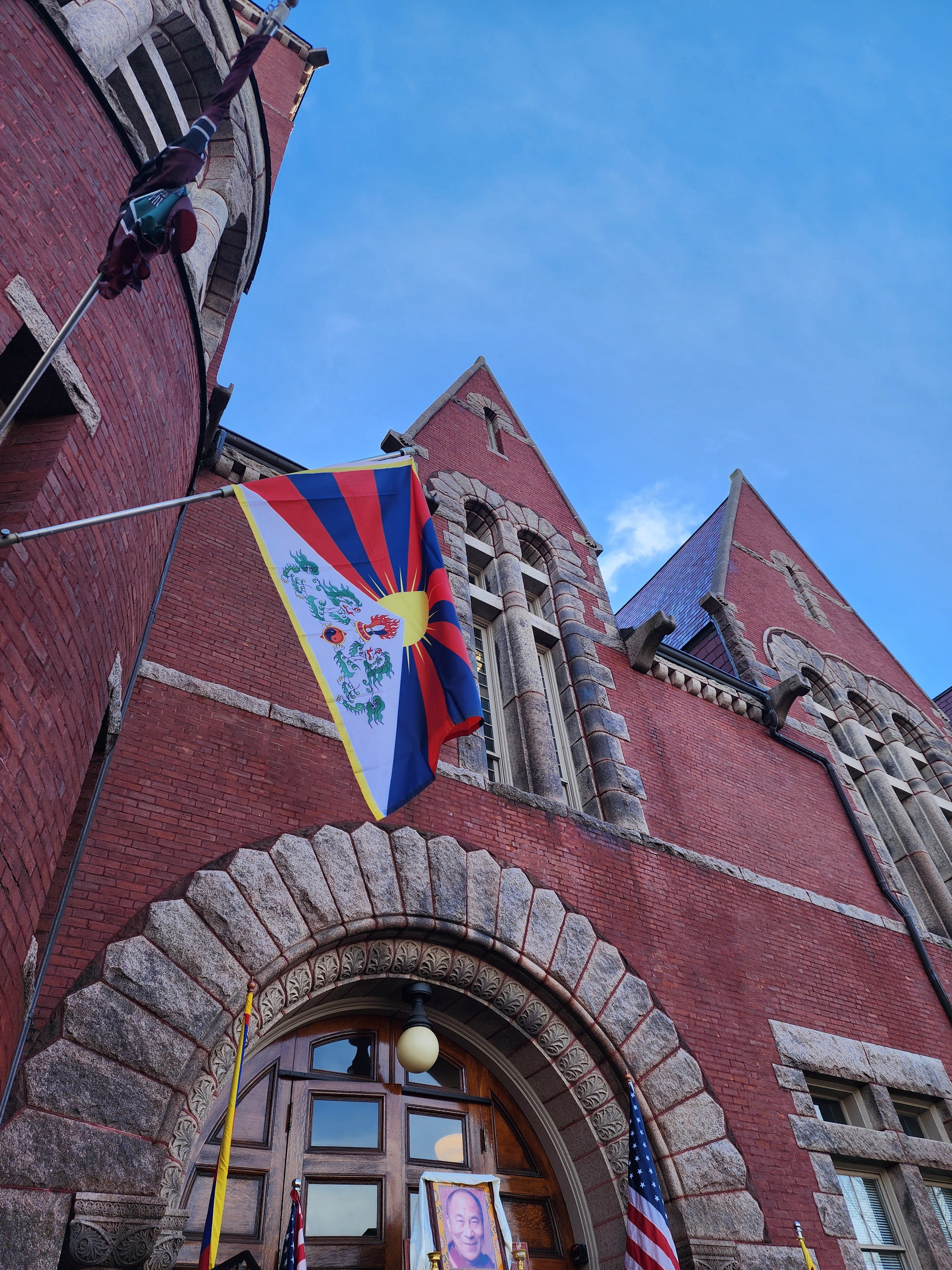
Each of these required time, listening, and a willingness to hold complexity. I don’t mention them to claim virtue, but to say: this is what engagement looks like for me. It’s slow. It’s specific. It requires investment in understanding context. And it’s always incomplete.
Was my Israel-Gaza resolution impactful? It was rejected. Perhaps it changed nothing. But I believe the process itself mattered. I believe that how we engage with suffering — the quality of our attention, the depth of our listening, the willingness to hold complexity — is itself a form of practice. It is dharma in action.
An Invitation
Vince said something in his podcast that gives me hope: that there were 400 years of relative coexistence under the Ottoman Empire’s Millet System. That the history is not simply one of endless bloody conflict. That peace is possible.
I believe that too. And I believe that peace will only come when both peoples — Israelis and Palestinians — can feel safe. Not because their suffering is equivalent, but because their futures are intertwined. The path forward requires us to hold the fullness of Palestinian suffering AND the reality of Israeli fear. Not as “both sides” equivalence, but as the recognition that you cannot build lasting peace on the erasure of anyone’s experience.
I resonate with Yuval Noah Harari’s framing of this issue: we cannot litigate history to resolve this conflict. We must ask what conditions would allow all the people living there now to live safely and thrive.
Questions I’m Sitting With
I don’t have all the answers. But I believe the dharma calls us to keep asking the questions — together. I am grateful to Vince for his courage to share his truth and ask hard questions. I’d love to hear your reflections:
What do you believe is the unique role of dharma teachers in times of widespread suffering?
How do you determine which issues call for your voice — and which call for deeper listening first?
What has skillful action looked like for you when facing complex, polarizing issues?
How do we hold the tension between the urgency to speak and the wisdom to understand before speaking?
Please share your thoughts in the comments. This is a conversation I want to have, not a position I’m trying to defend.
I’m including my full proposed resolution in a comment below. It was never adopted — there was no room for language that acknowledged both Palestinian rights and Israeli fears. I share it not as a perfect document, but as an example of one attempt to speak from complexity rather than collapse.
Thank you for this. Listening to both sides and taking both sides into account, is quite rare these days.
I read some American Dharma teachers' letters being completely one sided against Israel.
I must add that the Holocaust (where most of my family was anihilated), is not the source of our fears.
It is radical, fundamental, Islam. Those leaders that are willing to sacrifice their own people's children's lives to make Islam the only religion in the world. Those leaders that live wealthy (billionaire-worth!) lives out of Gaza.
It is the familiar story of power, money and ego. That is their motivation.
There is good and there is evil. Save Palestinian children from being brainwashed by these extreme, hateful people ruling them with terror, within Gaza.
Here in Israel, we must fight our own extremists. But our basic motivation remains peace, prosperity for all and liberal acceptance of all religions, genders and ways of life.
You are welcome to visit and see for yourself.
Thanks for your quick reply 🙏
Israel has a strong and growing community of Dharma teachers and students, and some teachers lead the protests against our own right-winged government which does have some extreme parties due to the democratic system here. These are loud ministers, but they don't have that much influence.
Israeli Dharma teachers lead humanitarian fund-raising for people in Gaza, though only those whome they know personally, as peaceful people.
Yuval Noah Harrari inspires me as well, and I pray for peace in the region.
My own son's house exploded by an Iranian missile. Luckily, he was in a shelter and his life was saved.
Each building here in Israel has a bomb-proof shelter, and we ran to the shelter several times every night, for months, shaking when bombs hit close.
Hamas had enough cement to build hundreds of kilometers of tunnels , tens of meters under ground for their army and to keep hostages under ground, but not one shelter for their babies and young children, counting on Israel's conscience. And still, under terrible circumstances, our soldiers did what they could, not to harm innocent people. Where ever that was not the case, we still have a strong, western, free, justice system and each case is investigated and brought to court.
Our soldiers are not mind washed. They are ordinary people - sons, fathers, daughters, mothers, brothers and sisters drafted to defend a tiny tiny country. Our tiny country though, is very strong, liberal, innovative, with leading scientists and strong will to live life fully. Our science and technology oriented country is why we were able to develop defensive anti missile rockets. Still, some very heavy missiles exploded on numerous civil buildings in several cities here.
I'm sorry for every innocent life taken, and as a buddhist follower, I am sorry for the souls of those people endangering their own families and wishing to annihilate us in the name of religion and hate.
Gaza children were their shelter. They said this several times, the tunnels being dug and accessed through schools, hospitals and mosks.
Save Gaza from Hammas. Not from Israel (many Gazans are just too afraid to say that, but some do say it).
Yours, Dahlia