


At the end of our practice in Sama Life Circle this week, one participant shared a single word that surprised me: self-confidence. We had just spent forty-five minutes exploring together the meaning of mindful focus and aligning the four intelligences — body, emotion, mind, spirit. And what came forward for them wasn’t sharper concentration. It was clarity about what to do next. A kind of quiet knowing.
That’s the heart of what we explored this week, and what I want to share with you in this report. When focus is practiced as the alignment of four intelligences rather than as single-pointed concentration, it doesn’t just sharpen attention. It restores access to your own inner knowing.
In this report, you’ll find:
A redefinition of focus as a whole-self practice
Why inner calm precedes focus — with a story from the Great Wall
The Two Wolves and the question of what we feed
The Power of Presence practice through the four intelligences
Reflections from the circle’s sharing
A special section on Mindful Focus for ADHD and Neurodivergent Brains
Your invitation for the two weeks ahead
Redefining Focus
When I asked the circle what comes to mind when I say focus, the answers came quickly and beautifully. Concentration. The ability to attend to a chosen task. Clarity. Discernment. The third eye. Flow — being so engaged you don’t get pulled away.
These are all true, and all incomplete. Focus is most often taught as sustained attention on a chosen object — primarily a cognitive skill. Useful, but it leaves out three-quarters of what we have available to us.
The anthropologist Angeles Arrien describes focus differently — as the alignment of four intelligences: mental, emotional, physical, and spiritual. This is how I’ve come to teach it, and how I describe it in Return to Mindfulness. Not focus as narrowing the beam, but focus as bringing all of yourself to what matters most in the present moment.
When all four come online together, something different happens. The speakers we admire — the ones who hold a room — aren’t just mentally sharp. They’re physically grounded, emotionally invested, and spiritually aligned with what they’re saying. That’s why we trust them. Their whole selves are there. This is what I call the power of presence. It is at the heart of practicing mindful focus.
This is also a practice in focusing with ease. Not the hunched-over-the-laptop, gritted-teeth version of focus, but the bamboo kind — strong and flexible, with the steady will of clarity but none of the brittleness of strain.
Inner Calm Comes First
Before we can focus with this kind of presence, we need calm. Not as preparation for the real practice, but as the foundation that makes focus possible.
I shared a story from a family trip to China. We were on the Great Wall, and our guide led us to a dilapidated section — close to vertical, broken stone, no railings, deep falls on either side. My husband and stepdaughter, athletic and experienced, walked on. I am not a hiker.
I had a choice: wait there, or take the wall one step at a time.
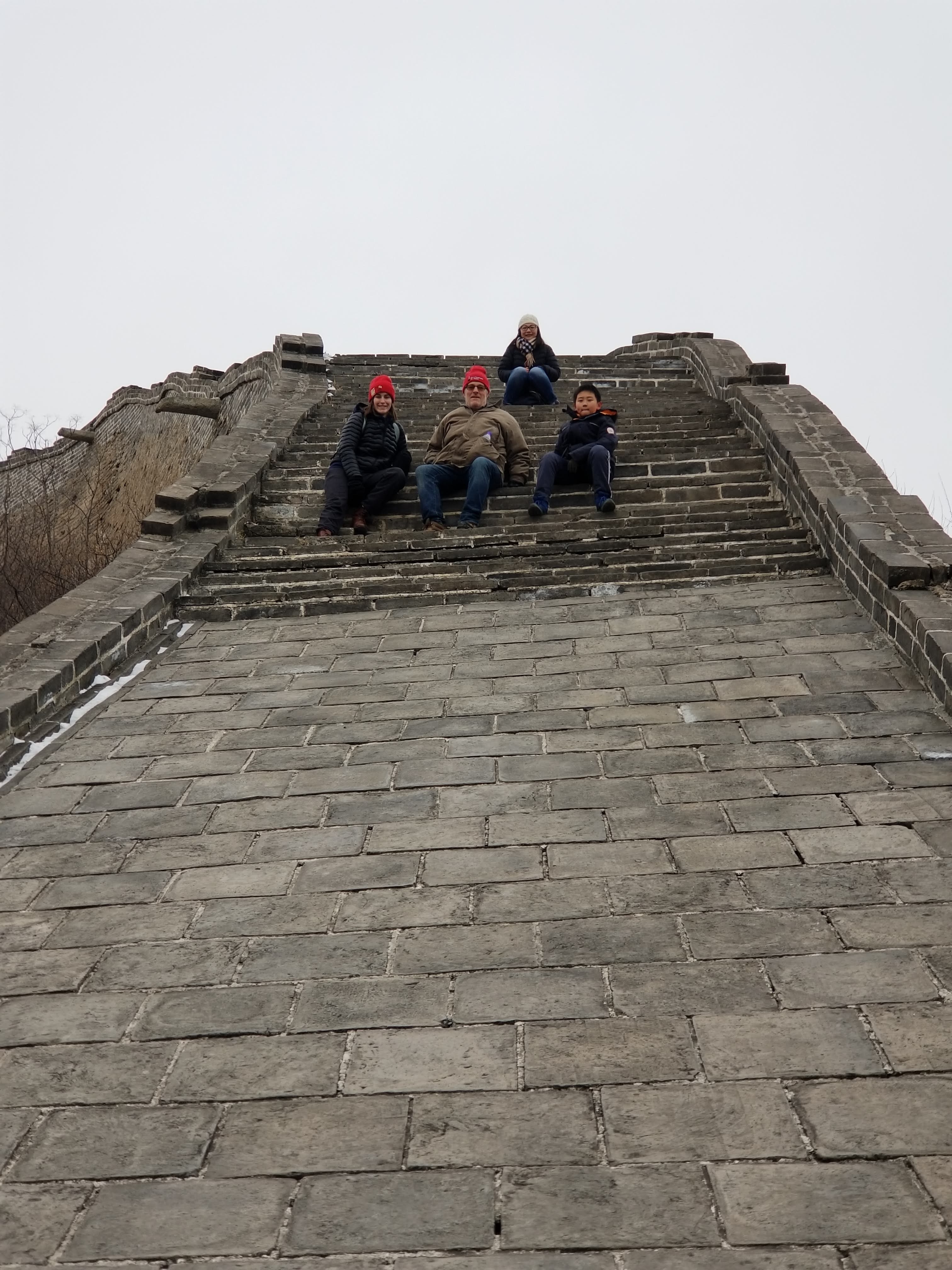
What I learned, step by careful step, was that inner calm wasn’t optional. It was the practice. Calm the mind. Calm the body. Take one step. Notice. Take another. The focus required to stay safe wasn’t something I could force with fearful mind and tensed body. It came from settling the mind and body.
This is why, in the Sama Life skills, Inner Calm precedes Focus. The ability to be with what is — without striving, without resisting — stabilizes us enough that we can then turn toward what matters.
The Two Wolves: What We Feed Grows
There is an old story about a grandfather who tells his grandchild that inside each of us are two wolves, always at war. One is fear, anger, comparison, self-criticism. The other is presence, kindness, generosity, curiosity.
The grandchild asks: Which one wins?
The grandfather answers: The one you feed.
This is the deeper layer of focus practice. William James, the father of modern psychology, said: My experience is what I agree to attend to.
“My experience is what I agree to attend to.”
—William James
Right now, millions of bits of information are entering your brain — sights, sounds, sensations, thoughts, memories, signals from inside the body. The brain cannot process all of it. So it filters. There is a system in the brain — think of it as a gatekeeper — that decides what reaches conscious awareness and what gets ignored.
In the absence of awareness, the gatekeeper runs on its own defaults. It tends to let in:
What feels pleasant (the dopamine hit, the comfort)
What’s fun or novel (the thing that catches the eye)
What’s familiar (the well-worn track of old habit)
Notice what’s missing from that list: what is most important. The brain’s default filter doesn’t prioritize what matters. It prioritizes what feels good, what’s stimulating, and what it’s used to.
This is where intention does its quiet, powerful work. When you set an intention — a sankalpa — you are sending a signal to the gatekeeper: this is what matters. This is what to let through. The filter recalibrates around what you’ve named as important. The brain begins to see, hear, and notice the things that serve that intention. The same room. The same noise. A different filter.
Without intention, the gatekeeper feeds whichever wolf is loudest, most familiar, most rewarded by old patterns. With intention, you set the filter. You decide which wolf to feed.
This is why morning intention matters. Why pausing before transitions matters. Why the question what is most important right now? is foundational, not optional. Each of these moments is a recalibration of the gatekeeper. Each one tells the brain: attend to this, not that.
What you focus on becomes the life you are choosing.
This isn’t a poetic line — it’s a chain of cause and effect.
What you choose to attend to determines what you notice. What you notice shapes what you feel. What you feel colors how you experience this moment. How you experience this moment shapes the decisions you make next. And your decisions, day by day, become the actual shape of your life.
Attention → noticing → feeling → experience → decisions → outcomes → life.
So focus is not a small skill. It’s not a productivity trick. It is the mechanism by which we live the lives we are actually living.
The same wind on a walk can be a mark of irritation or a marker of being alive — same wind, different attention, different day, eventually a different life. The same conversation with a partner can be connection or grievance — same words, different filter, different relationship over time.
Choose what you attend to, and you begin to choose your life.
The Practice: The Power of Presence
We did a guided practice together — longer than a micro-practice, shorter than a full meditation. I’ll share the longer recorded version separately.
The structure:
Settle. Breath. Body. Find the place that feels like home. Hands on chest or belly if the mind is busy.
Body intelligence. How is the body? Relaxed or tensed, alert or tired? What does it need? Maybe deeper inhales for tiredness, longer exhales for restlessness, or simply unconditional acceptance of the body as it is in this moment.
Emotional intelligence. What am I feeling? What needs to be acknowledged? Can I meet my emotions with kindness?
Mental intelligence. Where is the mind? Which thoughts deserve attention? Which can be released?
Spiritual intelligence. Why am I here? What matters in this moment? Listen within.
When the four align — even briefly — there is a quality of presence that is different from any one of them alone. From there, I invited each person to bring this aligned presence into a specific situation in their life: a conversation, a project, a relationship, a transition. To imagine showing up to that situation with all four intelligences online. And then to notice what shifts.
What Came Forward in the Circle
Several reflections came up in our sharing — each one a teaching in its own right.
One participant noticed how much time they spend in the mental “room,” and were surprised when entering the spiritual room brought up a wave of joy. The loving-kindness practice arose spontaneously: May I be happy. May I be healthy. May I be free of suffering. The discovery: when we stop and listen within, we know what we need.
Another found the practice connected them back to a sunny, windy walk earlier that day, and the gratitude they’d felt watching children play. The same wind they’d resisted (”colder than I would have liked”) became, in retrospect, a marker of being alive — something to befriend rather than push away. The story we tell about an experience is part of what we focus on. The same wind described as I don’t like this and as I’m alive, I can feel lives in two different worlds.
A third had a small moment that became a teaching for all of us. During the practice, their lips were dry and chapped, and they debated whether putting on lip balm would be “unacceptable” mid-meditation. They did it. They felt better. The discomfort had been quietly taking their focus.
This is the Buddha’s teaching of cause and effect: if there is suffering, there is a cause; if there is a cause, there is a solution. The skillful response is to address it without fuss. Mindfulness isn’t about white-knuckling through discomfort. It’s about being aware enough to identify what’s actually needed, and then doing it.
What surprised me most about this last sharing was what came at the end: a sense of self-confidence. Clarity about direction. The four intelligences in alignment had returned this person to their own knowing.
For me, this practice landed on the website project I’ve been working on for over a year. Bringing the four intelligences in, I noticed the tension I’d been carrying, the joy I’d been forgetting, the mind-wandering that needed a list, and — most importantly — why I was doing this in the first place. The spiritual intelligence reminded me that completion is not the point; service is. That alignment carried me back into the work with a different quality.
The Two Arrows: A Word About Resistance
Someone in our circle named the strain of transitioning between family and work — the expectation of showing up at full energy in each, and the punishment of not meeting that bar. This brought us to the teaching of the two arrows.
The first arrow is the inevitable pain of being human: tiredness, disappointment, sickness, transition fatigue. We don’t get to skip this arrow. But there is a second arrow — the story we tell about the first one, the resistance, the I shouldn’t be feeling this. That second arrow is the one we shoot at ourselves.
Acknowledging the first arrow — yes, I’m tired; yes, this is hard; yes, this hurts — isn’t weakness. It is the first act of care.
The first arrow is real pain. Tiredness is real. Disappointment is real. Trying to push through without acknowledgment doesn’t make it disappear; it just hides where it is, while it keeps doing its work underneath.
When we acknowledge the first arrow, two things become possible. We can actually do what’s needed to support ourselves — rest, eat, set down a task, ask for help, take a breath. And the second arrow — the story, the self-judgment, the I shouldn’t be feeling this — loses its grip. There’s nothing for it to attach to once we’re meeting the truth of the moment.
Without acknowledgment, we lose ourselves in the resistance. We spend our energy fighting the feeling instead of attending to what the feeling is actually asking for.
Sometimes the inability to focus is the first arrow speaking — your body or emotions trying to tell you that something needs attention before attention can land elsewhere. Listen. Then respond skillfully. That is the practice.
Special Section: Mindful Focus for ADHD and Neurodivergent Brains
A few of you wrote in this week with questions about ADHD, autism, hypermobility, chronic pain, and trauma. I want to speak to you directly here.
It’s not a willpower problem. Never was.
If you’ve tried meditation and “failed” at it — couldn’t sit still, couldn’t stop the wandering, couldn’t return to the breath — you weren’t doing it wrong. You were trying to do, with your particular brain, the very thing that brain finds hardest, with shame waiting at every wandering. That’s not a practice. That’s a setup.
What’s happening in there is real biology. Two things matter most:
The two systems run at the same time. In a neurotypical brain, the focused-on-the-task system and the wandering system take turns — when one is on, the other is off. In an ADHD brain, both run simultaneously. You’re answering the email and the inner monologue is also running. You’re listening and composing a grocery list. The part of the brain that should be saying stay here isn’t switching cleanly.
Dopamine signaling is different. Tasks that aren’t novel, urgent, interesting, or rewarding often genuinely can’t be started, no matter how much you want to start them. Also biology. Also not character.
So when you’ve felt like meditation wasn’t built for your brain — you may have been right. The version you were taught wasn’t.
A note while we’re here: ADHD brains are often more sensitive to sensory input — clothing tags, ambient noise, hunger, dry lips, restlessness. If something is taking your focus, address it. Put on the lip balm. Drink the water. Adjust your seat. That’s not a betrayal of the practice. That is the practice. Cause, effect, skillful response — without fuss.
The wandering isn’t the obstacle. It’s the practice.
This is the reframe I want you to take with you, even if you forget everything else.
The moment you notice your mind has wandered and gently bring it back — that is the moment of mindfulness happening. The wandering is the setup. The return is the practice.
ADHD brains wander more. Which means you get more reps of the actual skill than neurotypical brains do. You’re not behind. You’re getting better training material.
Four doorways, not one. And inner calm comes first.
Single-point concentration gives the wandering mind nowhere to go when it slips. The four intelligences — body, emotion, mind, spirit — give you four doorways instead of one. When the mind drifts, the body is still here. When the body is overwhelmed, emotion can be the way in. When emotion is too tender, returning to why am I here can ground the whole system.
You don’t have to use all four every time. You just need one to be reachable.
And remember: inner calm comes before focus. You cannot focus on a dysregulated nervous system. The first move, always, is to settle. Often through the body. Often through the senses.
Choose the practice that fits your moment
Below are the practices I teach. You don’t need to remember all of them. Scan the headlines. The one that matches what you’re feeling right now is the one to try.
When the breath is too subtle to feel → Sensory Grounding


